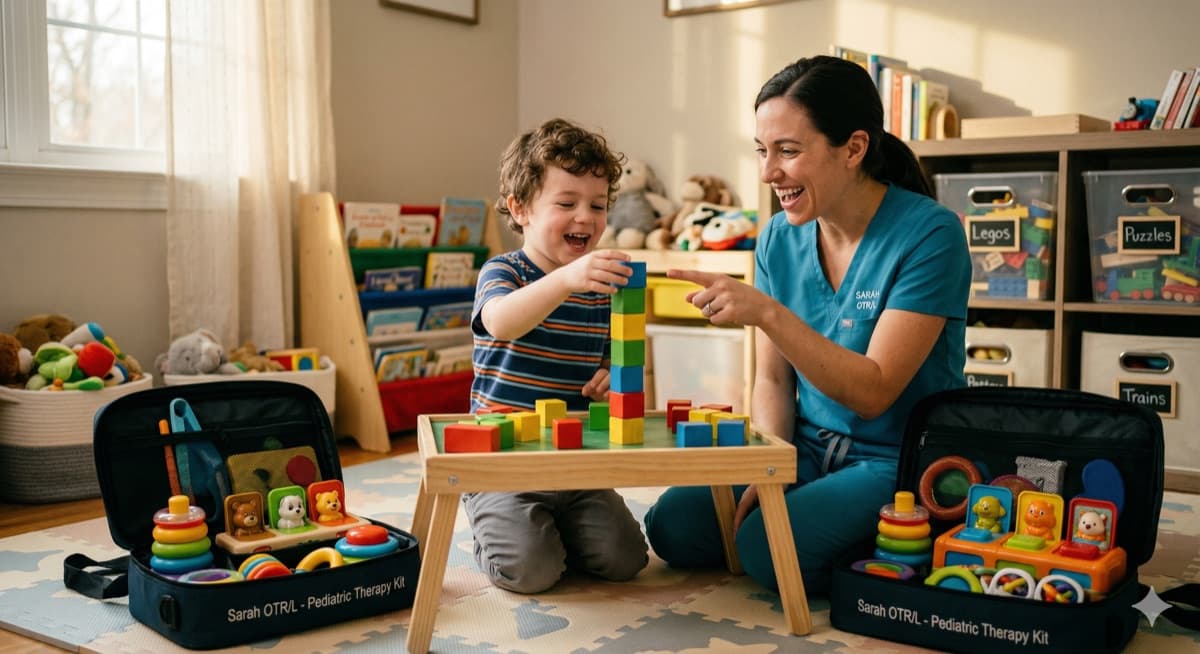
How this can show up at home, at school, and in play
Play Skills Development can affect play, attention, self-regulation, self-care, and school participation. Play is how young children learn school and friendship later. If play is stuck, we get in the play with your child and expand it, at home. When these challenges start creating frustration, fatigue, or added stress for the family, an evaluation can help clarify which skills need support most.
When it may be time to schedule an evaluation
If your child needs more help than expected with play, dressing, eating, writing, routines, or classroom participation.
If teachers or caregivers notice frequent frustration, avoidance, quick fatigue, or trouble keeping up with important skills.
If you want a clearer picture of what support could help now and how to build a plan for home and school.
What a care plan may include
Play-based therapy
developmental play coaching
imaginative play modeling
cause-and-effect exploration
peer interaction practice
and parent coaching for play at home
Therapies that may be part of the plan
Play is how young children learn everything else
Before a child can sit through a lesson or follow multi-step directions, they build those abilities another way. Through play. Imaginative play, cooperative play, figuring out how a toy works. When play skills lag behind, the gap tends to show up later. In school readiness, social connection, and problem-solving. Play was the training ground for all three.
What lagging play skills look like
It's not always obvious. A child might play alone even when others are around. Stick to the same repetitive activity without expanding on it. Struggle to take turns or follow a game's rules. Show little interest in pretend play at an age when peers are deep into it. None of these are character flaws. They're skills that haven't developed yet and can be built.
Meeting your child in play, not around it
We don't sit outside the play and direct it. We get in with your child, following their interest first and gently expanding it. A child stacking blocks becomes a child stacking blocks and inventing a story about them. That expansion is the actual therapy, even though it looks like playing.
Building toward peers
Cause-and-effect exploration builds early problem-solving through toys designed to teach it. Peer interaction practice is often the harder skill. It works on sharing, turn-taking, and reading another child's cues in real time, not just in theory.
What happens between sessions matters more
Parent coaching means you get specific ways to extend this play at home. During the hours we're not there, which is most of your child's week. Play skills grow through repetition across many small moments, not one weekly session alone.
Related conditions
If you are comparing similar symptoms or nearby diagnoses, these pages can help you understand related treatment options.
Autism Spectrum Disorder (ASD)
OT for autistic children builds the skills that make a day work: dressing, meals, sleep, transitions. We do that work in your home, not a waiting room.
Cerebral Palsy
No two children with CP move the same way. We build the plan around what your child can do today, in the house they actually live in.
Developmental Delays
A delay is not a life sentence. Early, play-based therapy in your home gives a child the best shot at catching up during the years that count.
Related articles
Practical information from our team to help you better understand this condition and treatment options.
We Qualified for DDD. What Happens Next?
August 11, 2026
Got your DDD eligibility letter? Here's exactly what Arizona families can expect in the first months, and the questions worth asking along the way.
Developmental Milestones: What to Watch For and When to Act
April 1, 2026
Understanding developmental milestones helps parents spot early signs that a child may benefit from occupational therapy. Learn what to watch for at each age and when to seek a professional screening.