How this can show up at home, at school, and in play
Social Skills Delays can affect play, attention, self-regulation, self-care, and school participation. Friendship is a skill, not a personality trait. We teach reading a room, turn-taking, and staying regulated enough to use those skills. When these challenges start creating frustration, fatigue, or added stress for the family, an evaluation can help clarify which skills need support most.
When it may be time to schedule an evaluation
If your child needs more help than expected with play, dressing, eating, writing, routines, or classroom participation.
If teachers or caregivers notice frequent frustration, avoidance, quick fatigue, or trouble keeping up with important skills.
If you want a clearer picture of what support could help now and how to build a plan for home and school.
What a care plan may include
Social interaction coaching
emotion identification
play-based peer modeling
pragmatic language strategies
and self-regulation during group activities
Therapies that may be part of the plan
Friendship is a skill, not just a personality trait
Some kids seem to make friends effortlessly. Others want connection and can't figure out why it keeps going wrong. Missing a social cue. Talking over a peer without noticing. Struggling to lose a game gracefully. These aren't signs a child doesn't care about friendship. Often they care intensely and don't yet have the specific tools.
Reading a room is a learnable skill
Emotion identification and perspective-taking sound abstract, but they're concrete, teachable skills. Recognizing that a friend's crossed arms and quiet voice mean something different than their words. Understanding why a joke landed differently than intended. We break these down into pieces a child can actually practice.
Practice happens through play, not lectures
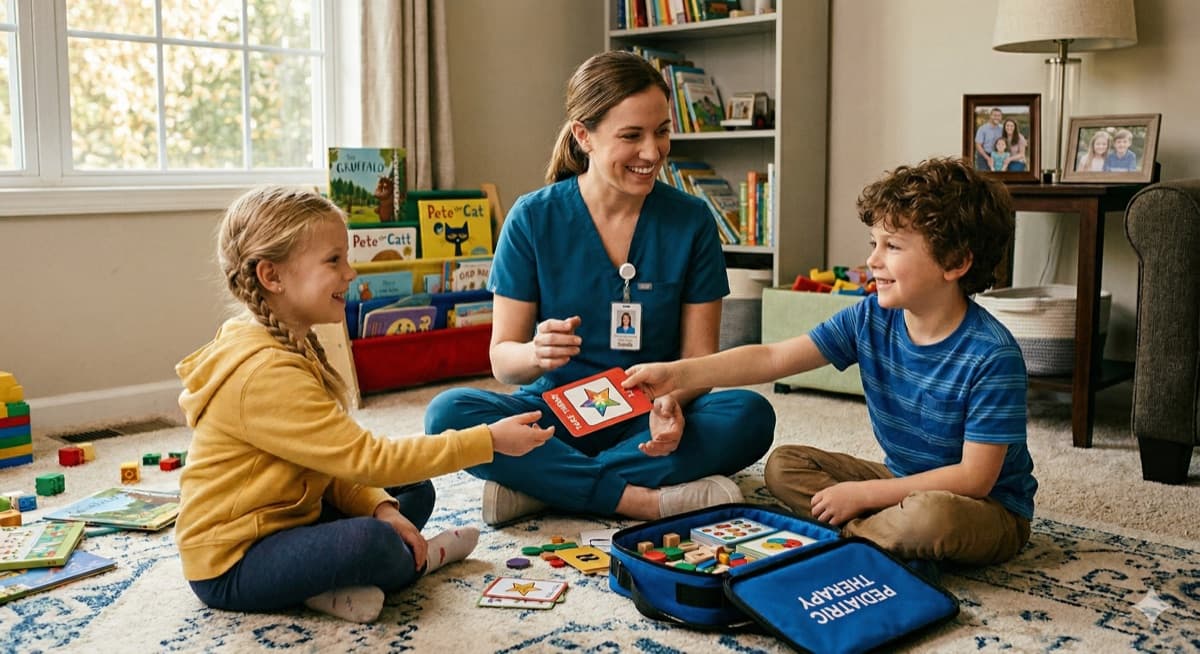
Structured play activities let a child practice turn-taking and sharing in a low-stakes setting, with real-time coaching in the moment rather than a talk about it afterward. That immediacy is what makes the skill actually transfer to the playground.
The language side of social skills
Pragmatic language, the practical use of language in conversation, covers things like knowing when to change topics, how close to stand, and how to join a group already playing without disrupting it. These unwritten rules are obvious to some kids and invisible to others. They can be taught directly.
Staying regulated enough to connect
Self-regulation work matters here because a dysregulated child can't access social skills even when they've learned them. If a child is overwhelmed, frustrated, or overstimulated, the social strategies go out the window. We build the regulation piece alongside the social piece, not as an afterthought.
Related conditions
If you are comparing similar symptoms or nearby diagnoses, these pages can help you understand related treatment options.
Autism Spectrum Disorder (ASD)
OT for autistic children builds the skills that make a day work: dressing, meals, sleep, transitions. We do that work in your home, not a waiting room.
Cerebral Palsy
No two children with CP move the same way. We build the plan around what your child can do today, in the house they actually live in.
Developmental Delays
A delay is not a life sentence. Early, play-based therapy in your home gives a child the best shot at catching up during the years that count.
Related articles
Practical information from our team to help you better understand this condition and treatment options.
We Qualified for DDD. What Happens Next?
August 11, 2026
Got your DDD eligibility letter? Here's exactly what Arizona families can expect in the first months, and the questions worth asking along the way.
Developmental Milestones: What to Watch For and When to Act
April 1, 2026
Understanding developmental milestones helps parents spot early signs that a child may benefit from occupational therapy. Learn what to watch for at each age and when to seek a professional screening.