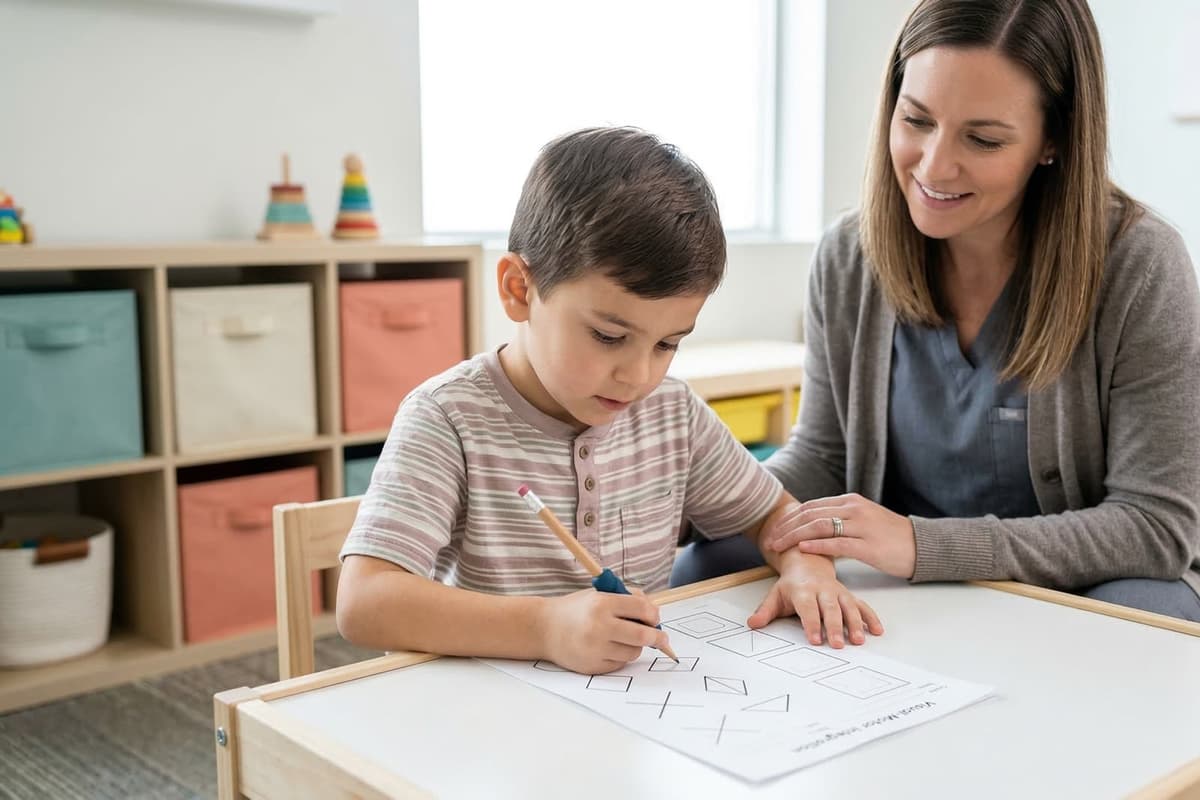
How this can show up at home, at school, and in play
Visual-Motor Integration Difficulties can affect play, attention, self-regulation, self-care, and school participation. A child can see fine and still miss the line, the catch, or the copy-from-the-board task. We train the eye-hand connection underneath schoolwork. When these challenges start creating frustration, fatigue, or added stress for the family, an evaluation can help clarify which skills need support most.
When it may be time to schedule an evaluation
If your child needs more help than expected with play, dressing, eating, writing, routines, or classroom participation.
If teachers or caregivers notice frequent frustration, avoidance, quick fatigue, or trouble keeping up with important skills.
If you want a clearer picture of what support could help now and how to build a plan for home and school.
What a care plan may include
Visual tracking activities
copying and pre-writing practice
cutting and bilateral coordination work
spatial awareness strategies
and tasks that improve worksheet and classroom performance
Therapies that may be part of the plan
When the eyes and the hands don't quite agree
Visual-motor integration is what lets you look at something and have your hand do the right thing in response. Copying a shape. Catching a ball. Cutting along a line. When that connection is weak, a child can see perfectly well and still struggle to translate what they see into accurate movement. That gap is often mistaken for carelessness or not trying hard enough.
The school tasks this quietly sabotages
Copying from the board. Staying inside the lines when coloring. Cutting along a curve. Completing a puzzle. All of these depend on visual-motor integration more than raw intelligence or effort. A child can understand the material completely and still turn in messy, inaccurate work. It's not laziness, the eye-hand connection just hasn't caught up yet.
Building the connection directly
Visual tracking activities train the eyes to follow and fixate accurately. That has to work well before the hands can respond to what the eyes see. Copying and pre-writing practice builds a specific skill: translating a visual shape into a matching hand movement. We do this deliberately, not leave it to develop on its own.
Two hands working together
Cutting and bilateral coordination work targets one hand stabilizing while the other does a precise task. It underlies far more school tasks than people expect. Cutting. Folding. Holding paper steady while writing.
Spatial awareness ties it together
Spatial awareness strategies help a child understand where objects and their own body are in relation to each other. That affects everything from staying within margins to navigating a crowded hallway. We build toward functional tasks specifically. Worksheet performance. Classroom participation. Not abstract drills disconnected from what your child needs to do every day.
Related conditions
If you are comparing similar symptoms or nearby diagnoses, these pages can help you understand related treatment options.
Autism Spectrum Disorder (ASD)
OT for autistic children builds the skills that make a day work: dressing, meals, sleep, transitions. We do that work in your home, not a waiting room.
Cerebral Palsy
No two children with CP move the same way. We build the plan around what your child can do today, in the house they actually live in.
Developmental Delays
A delay is not a life sentence. Early, play-based therapy in your home gives a child the best shot at catching up during the years that count.
Related articles
Practical information from our team to help you better understand this condition and treatment options.
We Qualified for DDD. What Happens Next?
August 11, 2026
Got your DDD eligibility letter? Here's exactly what Arizona families can expect in the first months, and the questions worth asking along the way.
Developmental Milestones: What to Watch For and When to Act
April 1, 2026
Understanding developmental milestones helps parents spot early signs that a child may benefit from occupational therapy. Learn what to watch for at each age and when to seek a professional screening.