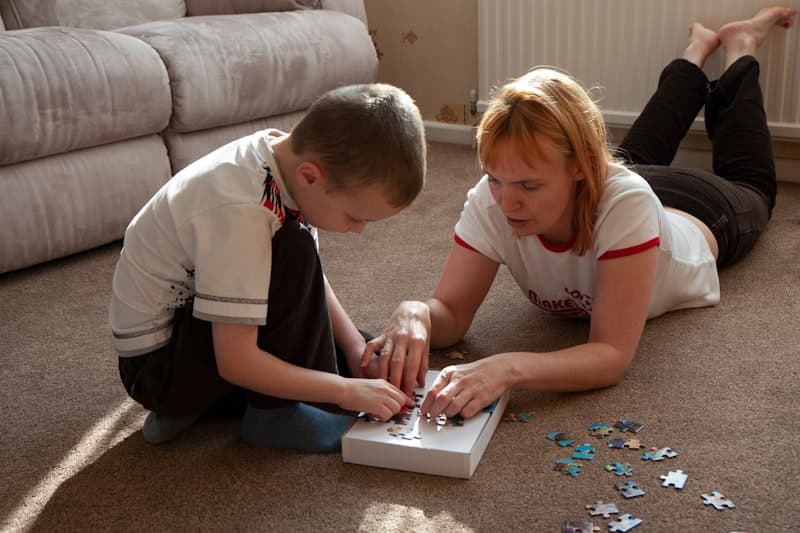
How this can show up at home, at school, and in play
Intellectual Disabilities can affect play, attention, self-regulation, self-care, and school participation. Therapy here builds the day: dressing, routines, communication, and a next step after school. We start from what already works. When these challenges start creating frustration, fatigue, or added stress for the family, an evaluation can help clarify which skills need support most.
When it may be time to schedule an evaluation
If your child needs more help than expected with play, dressing, eating, writing, routines, or classroom participation.
If teachers or caregivers notice frequent frustration, avoidance, quick fatigue, or trouble keeping up with important skills.
If you want a clearer picture of what support could help now and how to build a plan for home and school.
What a care plan may include
Adaptive skill training
assistive technology
school to work transition interventions
sensory interventions and approaches
Therapies that may be part of the plan
Building the skills that make a day work
An intellectual disability affects how someone learns and processes information, but the goal of therapy isn't to change that. It's building the practical, everyday skills that let a person participate more fully at home, at school, and eventually at work. Dressing. Managing money. Following a routine. Communicating what they need.
Meeting someone where they are
Every plan starts with what a person can already do, not a checklist of what they can't. We build from real strengths toward real independence, at a pace that respects how that individual actually learns, not a generic timeline.
What the work looks like
Adaptive skill training breaks daily tasks into steps. A person can master each one and build on it, at their own pace. Assistive technology opens doors that skill training alone can't, when it helps. A communication device. A simple visual schedule. Sensory approaches address how a person takes in and responds to their environment, since sensory differences often affect intellectual disabilities too.
Planning for what comes next
For older kids and teens, school-to-work transition work starts well before graduation. Job-readiness skills, workplace routines, self-advocacy. The goal is a real, achievable next step, not a vague hope that things will work out.
Working with the whole team
We coordinate closely with schools, families, and other providers. The strategies that work at home should also work in the classroom, and the goals in an IEP should reflect what's actually happening day to day.
Related conditions
If you are comparing similar symptoms or nearby diagnoses, these pages can help you understand related treatment options.
ADHD
Kids with ADHD often know the steps. Starting them, sequencing them, and getting out the door is the hard part. We build that at home.
Traumatic Brain Injury (TBI)
No two brain injuries recover the same way. We assess movement, memory, attention, and follow-through, then rebuild daily life at home and school.
Bell's Palsy
When one side of the face stops moving overnight, we protect the eye first, then retrain the nerve-to-muscle connection as it heals.
Related articles
Practical information from our team to help you better understand this condition and treatment options.
We Qualified for DDD. What Happens Next?
August 11, 2026
Got your DDD eligibility letter? Here's exactly what Arizona families can expect in the first months, and the questions worth asking along the way.
Developmental Milestones: What to Watch For and When to Act
April 1, 2026
Understanding developmental milestones helps parents spot early signs that a child may benefit from occupational therapy. Learn what to watch for at each age and when to seek a professional screening.